My aunt cosigned my student loans, but 12 years later I’m determined never to do the same

November 5, 2019

By Kelly Burch, Business Insider

college graduate student

During my freshman year of college, there was a five-figure gap between what my financial aid covered and what tuition cost. In hindsight, I should have seen that bill and run to my nearest community college, since the four-year university I was planning to attend was clearly unaffordable.

Instead, I turned to private student loans to cover the cost. As a broke 18-year-old with no official work history, I couldn’t get approved for a private student loan on my own. My parents couldn’t either because of their credit histories. I was panicked, until an aunt offered to cosign an $18,000 loan.

I was incredibly grateful at the time, and still am today. That loan allowed me to get started in a journalism program that kickstarted my career. However, in the 12 years since that loan was dispensed, I’ve learned a lot about cosigning.

I recently refinanced the loan in my own name, and I’ll never ask for a cosigner again. And though I am incredibly grateful for the gift my aunt gave me, I’ll never be a cosigner myself. Here’s why.

Cosigning affects you, even if everything goes well

Many people think a cosigner is merely a backup payee. If the primary borrower doesn’t pay, the lender can go to the cosigner, who is also responsible for the loan. If you think about cosigning this way, there’s little risk, as long as you believe the primary borrower will hold up their end of the deal.

However, that’s not the full picture. When you cosign a loan, it shows up on your credit report. Lenders consider cosigned debt just the same as they would consider debt where you’re the primary borrower. It affects your all-important debt-to-income ratio, which can limit your ability to get additional credit in the future. That means that even if the person you cosigned for is doing everything right, their loan can still change your financial situation.

To Read More, Click Link Below

https://www.businessinsider.com/aunt-cosigned-student-loans-ill-never-cosign

Advice for getting student loans forgiven, from borrowers who did it

October 17, 2019

By Ana Helhoski, MarketWatch

Pursuing student loan forgiveness entails a decade of meticulously recorded payments, hours on hold with your servicer and infinite patience. Success, however, arrives without much fanfare.

Public defender Shelly Tomtschik was in court when she got the email notifying her that the quest was over:

“Congratulations! After final review of your Public Service Loan Forgiveness (PSLF) application and payment history, we have determined that you have successfully made the required 120 monthly payments in order to have the loans listed below forgiven.”

“It wasn’t hitting me,” says Tomtschik, 40, of Baldwin, Wisconsin. “I thought it would be more official or something.”

Tomtschik is among the first federal student loan borrowers to get their loans canceled tax-free through the federal Public Service Loan Forgiveness program. The program, launched in 2007, forgives any outstanding balance after 120 qualifying payments for borrowers who take traditionally lower-paying public service jobs.

But the process is tricky. Just 864 of the 88,006 applications filed had been approved as of March 2019, based on the most recently available data from the Education Department. The average amount forgiven: $59,244.
What it takes to get public student loan forgiveness

To qualify for PSLF, borrowers must make 120 monthly, on-time payments while working full time in public service for a qualifying employer. You also must:

Ensure you have only federal direct loans. Some borrowers will need to consolidate into a direct loan. Private loans aren’t eligible.

Enroll in an income-driven repayment plan. Your payments will be a portion of your discretionary income.

Make sure your loans are serviced by FedLoan Servicing, the only company that processes PSLF applications. You can do this by submitting an employer certification form.

Submit employer certification forms to prove you worked for a qualifying government or nonprofit employer while making all 120 payments.

Apply while you’re still working for an eligible employer.

Tomtschik and another successful applicant, Bonnie Svitavsky, a librarian in Washington state, might add another requirement: Document everything.

Svitavsky, a 38-year-old supervising librarian at Pierce County Library, made payments for two years before she found they wouldn’t count toward PSLF. That’s because her loans weren’t enrolled in an eligible repayment plan.

“It was disappointing, to say the least,” she says.

To avoid any future surprises, Svitavsky set alarms to submit certification forms and logged the details of calls to FedLoan.

To Read More, Click Link Below
https://www.marketwatch.com/story/advice-for-getting-student-loans-forgiven-from-borrowers-who-did-it-2019-10-07

In The News: FTC to pay more than $5.4 million to people scammed by student loan debt relief fraudsters

October 3, 2019

By Jeanette Settembre, Fox Business

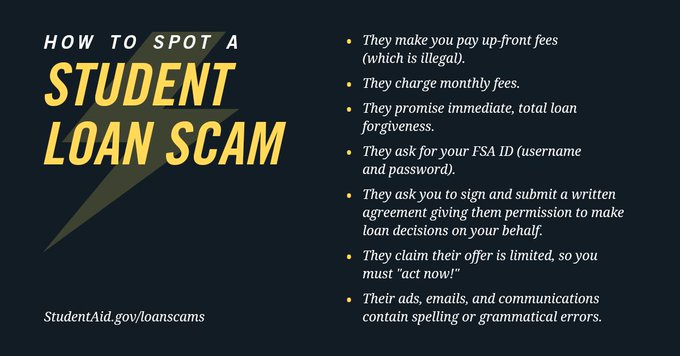
The fraudsters, who made off with at least $20 million, were required to pay up under a 2018 settlement with the FTC, the organization announced in a press release Monday.

The FTC alleged that Los Angeles-based companies using names like Alliance Document Preparation LLC, and Post Grad Aid, bilked millions of people trying to reduce or eliminate their student loan debt. They used social media platforms like Facebook to market their fake relief programs and misrepresented that they were affiliated with the U.S. Department of Education or the loan servicers. The defendants falsely claimed that consumers who paid an upfront fee of up to $1,000 were qualified or approved for permanently reduced monthly payments or loan forgiveness.

The FTC is sending 39,734 checks to people who lost their money, totaling $136.48 each on average. The checks will expire after 60 days, the FTC said, noting: “The FTC never requires consumers to pay money or provide account information to cash a refund check.”

Borrowers have reported receiving emails, letters and phone calls offering them financial relief from their federal student loans. In most cases, these companies don’t offer any relief at all and just take people’s money. One of the most common ways fake companies try to swindle those saddled with debt is by claiming they’ll get rid of student loans without the person having to pay it back, for a small fee. The only legitimate reasons for not paying student loans may include permanent disability, identity theft or in some cases, school closure.

America’s $1.6 trillion student loan crisis has some presidential candidates proposing to cancel student debt and make public college free. And state legislatures are cracking down on student-loan companies.

To Read More, Click Link Below:

https://www.foxbusiness.com/money/ftc-to-pay-more-than-5-4-million-to-people-scammed-by-student-loan-debt-relief-fraudsters

In The News: Millennials have an average of $28,000 in debt—and the biggest source isn’t student loans

September 20, 2019

By Megan Leonhardt, CNBC

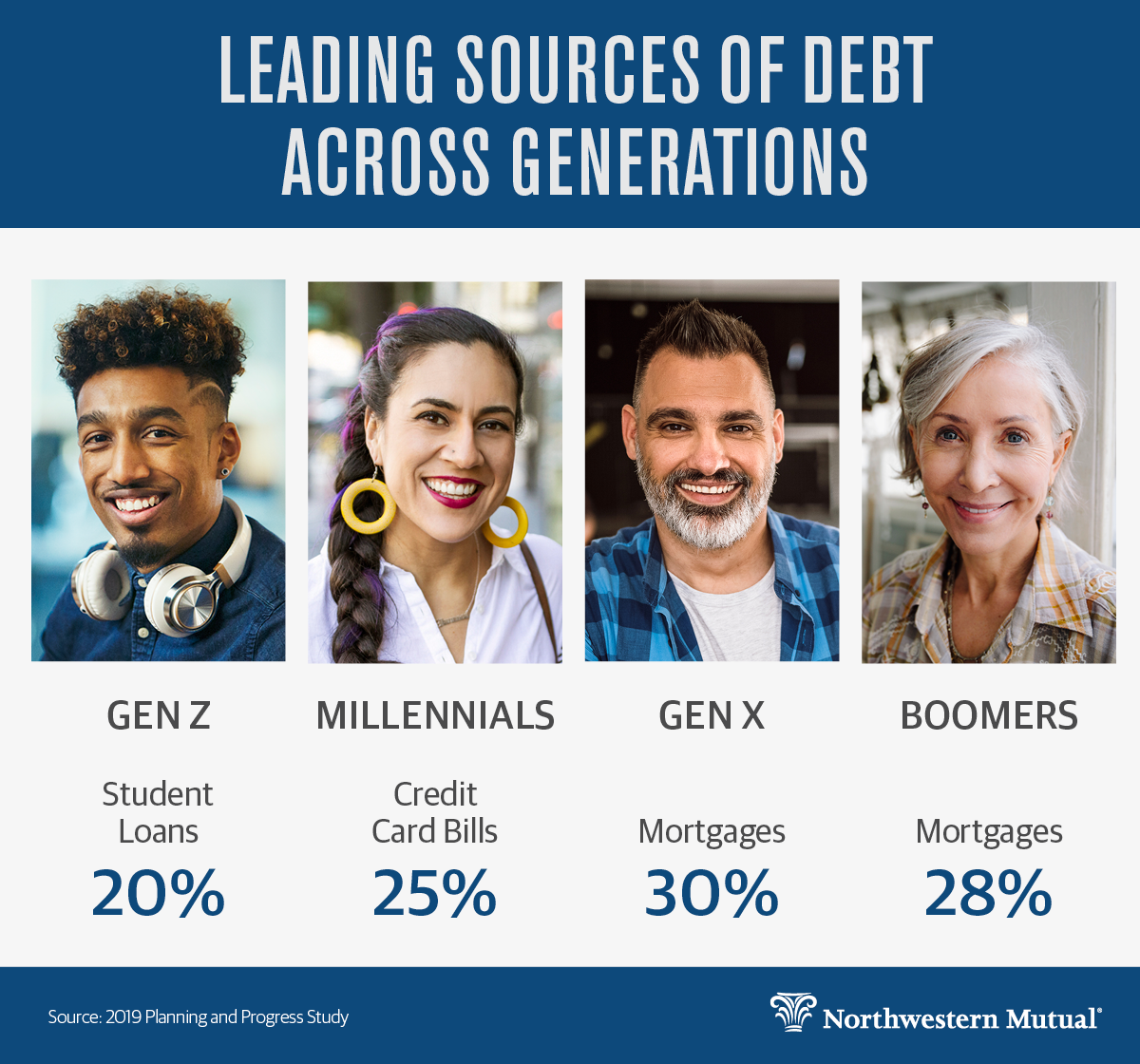
It may seem like student loans and millennials are inextricably linked. But a new survey shows that education bills are not the leading source of debt among this generation.

Millennials (defined here as ages 23 to 38) have racked up an average of $27,900 in personal debt, excluding mortgages, according to Northwestern Mutual’s 2019 Planning & Progress Study. The findings are based on a survey conducted by The Harris Poll of over 2,000 U.S. adults.

The biggest source of debt? Credit card bills. And that’s a “troubling” trend, Chantel Bonneau, a financial advisor with Northwestern Mutual, tells CNBC Make It.

“One issue that a lot of millennials have is that they have not wanted to sacrifice their lifestyle, even though they have student loans or lower incomes,” Bonneau says. “That has left us in this spot where they’ve accumulated a significant amount of credit card debt.”

To Read More, Click Link Below:

https://www.cnbc.com/2019/09/18/student-loans-are-not-the-no-1-source-of-millennial-debt.html